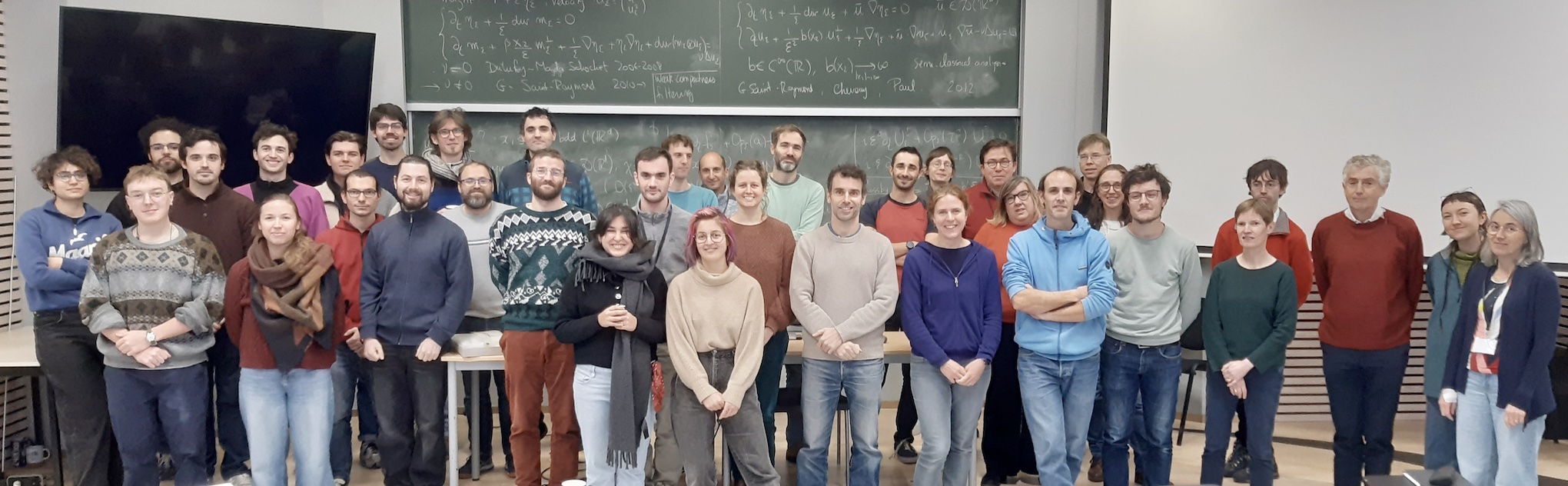
Oceans play a central role in the climate system by storing heat and CO2, and redistributing these tracers across the planet. Their turbulent nature, involving a vast range of spatial and temporal scales, makes their modeling challenging. However, certain robust features, such as western intensification, equatorial jet formations, and overturning circulations, can be explained from basic physical principles. The aim of this school is to provide introductory lectures on the core concepts of planetary-scale ocean dynamics, as well as to present current theoretical challenges that will need to be addressed in the coming years, driven by new observations and modeling capabilities. This school will bring together physicists, mathematicians, and oceanographers, with introductory lectures providing common ground and state-of-the-art advances on the topic, with the goal of fostering new collaborations between these communities.
Lectures
The Atlantic Meridional Overturbing Circulation (Casimir de Lavergne)
Equatorial waves and mean flows (Isabelle Gallagher)
Equatorial oceanography (Claire Ménesguen)
Laboratory experiments (Sylvain Joubaud, Julien Salort, Benjamin Apffel, Guillaume Ricard)
Hands on with jupyter notebooks (Louis Couston, Corentin Herbert, Louis Saddier)
Practical details
The school took place in salle des thèses, ENS Lyon site Monod, 46 allée d'Italie, 69007 Lyon, from Monday, november 17 1:30pm to Friday november 21, 1:30pm.
All participants had the opportunity to present a poster during the ice-breaking welcome session on Monday evening.

 Loading...